Could you or someone you know use a Friendly Phone call?
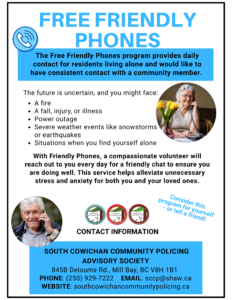
Our Friendly Phones Program establishes daily contact with residents who live alone and/or have medical problems, but it’s more than just a phone call. We offer peace of mind and reassurance that someone cares about your well-being and safety. We are happy to say the program now runs seven days a week, 365 days a year.
Our volunteers make friendly phone calls and establish daily contact with those who:
- are living alone
- have medical problems
- need reassurance that someone cares
- need some peace of mind
- need extra safety

Free Service!
Call our office at (250) 929-7222 to sign up and join our daily call list.
Participants can pause and resume this service as needed.
How the program works:
An interview is conducted with each client and a short history is recorded. All information is confidential and secure.
We know that every client has different needs so we offer three different options for daily contact:
- A daily phone call from our dedicated Friendly Phones volunteer at an agreed upon time
- Client sends an email to the office prior to an agreed upon time and we reply via email
- Client calls our voice mail prior to an agreed upon time and leaves a message
If, at the appointed time, the client does not answer the phone or has not contacted us, then a plan will be implemented to address the safety and well-being of the client. This includes communicating with backup contacts the client has identified during the interview.
We welcome referrals for the Friendly Phones Program from the general public, doctors, long term care workers, health professionals, or any community member.
This program is FREE! Click this link to our Friendly Phones Client Application to get started, then give us a call to arrange a time to drop into our office and complete the registration process. If coming to the office is difficult, we can arrange to come to you!
If you would like to become a Friendly Phones volunteer, click this link for more information on how to join our volunteer team.
Check out BC Association of Community Response Networks’ (BCCRNS) World Elder Abuse Awareness Day
- Physical Activity is Key: Regular movement, regardless of intensity, is crucial for maintaining physical health, preventing chronic diseases, improving mobility, and reducing the risk of falls. This includes everything from walking and gardening to structured fitness classes.
- Mental Engagement Matters: Staying mentally stimulated through learning, puzzles, reading, or new hobbies helps to maintain cognitive function and reduce the risk of cognitive decline.
- Social Connection is Vital: Combatting isolation and loneliness through social interaction, community involvement, and intergenerational activities significantly impacts mental well-being and overall happiness.
- Holistic Health: The concept emphasizes that health is not just the absence of illness, but a comprehensive state of physical, mental, emotional, and social well-being.
